Best Health Insurance Companies in Florida for 2027
Florida Blue is the best company in Florida overall, but Capital Health and Ambetter are usually cheaper options


Advertising Disclosures
Loading Disclosures…
- Florida Blue is our pick for best health insurance company in Florida. It offers a wider variety of plans than most other companies and is available statewide.
- Capital Health sells the cheapest Silver health insurance in Florida, with average rates of $717 per month.
- In Jacksonville, Tampa and Orlando, Ambetter has the cheapest Silver plan.
- Health insurance in Florida costs an average of $978 per month for a Silver plan.
Best health insurance in Florida
Flexible coverage options help make Florida Blue the best health insurance company in Florida. You can get it in every Florida county, and it offers a wide range of plans.
Other companies stand out for different reasons. Capital Health Plan has the state’s cheapest average health insurance rates, and Ambetter has cheap rates in several of Florida’s major cities. It’s good to compare health insurance quotes from a few companies to find the best plan.
Best Florida health insurance company overall: Florida Blue

Monthly rate (Silver plan): $1,263
Why we chose it: Florida Blue is the only company in Florida that offers PPO plans, which let you see any doctor and still have some level of coverage. If you travel often or just want more freedom to choose your doctor outside of your plan’s network, Florida Blue is a great choice.
Who it’s best for: Florida Blue is best for most Floridians because its wide variety of plans gives you more options to choose from. For example, it offers PPO and EPO plans, which let you see specialists without first getting a referral from your primary doctor. (EPO plans don’t allow you to go out of network, however.)
Florida Blue HMOs get an average rating of 3-out-of-5 from the Centers for Medicare & Medicaid Services (CMS)
CMS rates plans on factors like how well they provide access to care and member feedback. Higher scores are better on its 5-point scale.
PROS
- More plan options than most other companies
- Available statewide
- Good NAIC complaint score
CONS
- Rates can be expensive
- Not the highest HealthCare.gov rating
Cheapest Florida health insurance rates: Capital Health Plan

Average monthly rate (Silver plan): $717
Why we chose it: Capital Health Plan charges an average of $717 per month for a Silver plan. This is the cheapest rate in Florida, at about 27% less than the state average.
Who it’s best for: Capital Health Plan is best for residents who live in Florida’s panhandle, are looking for cheap rates and are willing to take a gamble on customer service. Capital Health Plan gets a rating of 4-out-of-5 from the CMS, which means it typically has high plan quality and good reviews on HealthCare.gov. However, Capital Health plan gets about 40% more complaints than expected, according to the NAIC, which might mean people have trouble dealing with the company.
PROS
- Cheapest Silver plans in Florida
- Good HealthCare.gov complaint rating
- Also sells cheap Bronze plans
CONS
- Only available in nine counties in Florida’s panhandle
- More complaints than average, per the NAIC
Best in Jacksonville, Tampa and Orlando: Ambetter

Average monthly rate: $778
Why we chose it: Ambetter has the cheapest rates in Jacksonville, Tampa and Orlando, three of Florida’s major cities.
Who it’s best for: Ambetter is a good option if you live in Jacksonville, Tampa or Orlando and you’re looking for a cheap plan. The company is also good if you want a Bronze plan; the company has the second-cheapest Bronze plan in the state, starting at $492 per month.
However, Ambetter’s plans are too new in Florida to have a rating from HealthCare.gov, and the company also doesn’t have any complaint data from the NAIC. That means it could be hard for you to gauge Ambetter’s customer service or plan quality in Florida before you buy a plan.
PROS
- Cheapest Silver rates in Jacksonville, Tampa and Orlando
- Cheap Bronze plans in Florida
- Widely available throughout the state
CONS
- No customer service or plan quality ratings
- Deductibles can be high
Compare health insurance plans in Florida
| Company | NAIC rating | CMS score | Monthly rate | |
|---|---|---|---|---|
| Capital Health Plan | 1.42 | 4 | $717 | |
| Health First | 0.49 | 3 | $771 | |
| Ambetter | N/A | N/A | $778 | |
| AmeriHealth Caritas | 0.00 | 2 | $784 | |
| Oscar | 0.74 | N/A | $815 | |
| Florida Health Care Plans | 0.83 | 4 | $817 | |
| 22 Health | N/A | N/A | $820 | |
| AvMed | 0.30 | 3 | $866 | |
| Wellpoint | 0.00 | N/A | $872 | |
| UnitedHealthcare | 2.33 | 2 | $1,007 | |
| Florida Blue | 0.54 | 3 | $1,263 |
LendingTree analyzed companies in the Health Insurance Marketplace to find the best options for you and your family.
Our team evaluated the costs of marketplace plans and customer service ratings from reliable industry and government sources.
See our full methodology.
Average cost of health insurance in Florida
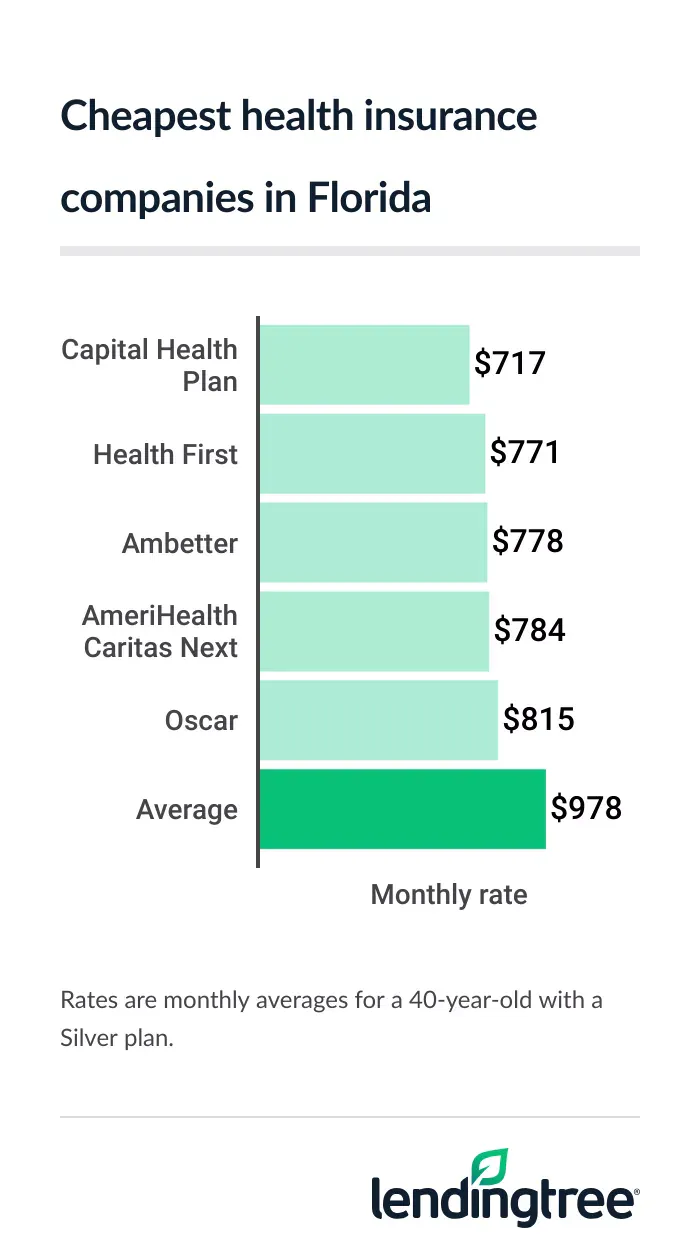
The average cost of health insurance in Florida is $978 per month for Silver marketplace plans.
The price you pay depends on factors such as your age, location and your plan’s features. You’ll pay less if you qualify for subsidies.
Marketplace plans are offered in metal tiers. Gold and Platinum plans cost more than Silver plans, while Bronze plans are cheaper.
Health insurance rates by plan tier
| Plan tier | Average monthly rate |
|---|---|
| Catastrophic | $532 |
| Bronze | $630 |
| Silver | $978 |
| Gold | $1,209 |
| Platinum | $2,264 |
In addition to your monthly rate, it’s important to account for your out-of-pocket costs for doctor visits, tests and other services. These costs include:
- Your plan’s deductible: This is the amount you pay for care during the year before your plan starts paying for services.
- Coinsurance: This is the percentage of costs you cover after you’ve met your deductible. If your plan has 30% coinsurance, your insurance company covers 70% of eligible expenses. You’re responsible for the remaining 30%.
- Copayments/copays: These flat fees are for some services and help keep your out-of-pocket costs affordable. Copayments don’t count toward your deductible.
- Out-of-pocket maximum: Your policy’s out-of-pocket maximum is the most you could have to pay for care in a year. Your insurance company covers 100% of your eligible expenses above this amount. This protects you from larger costs if you need extensive care for an injury, illness or something else.
Bronze plans usually have higher deductibles and out-of-pocket limits than other tiers. Gold and Platinum plans cost the most upfront but have the lowest out-of-pocket requirements.
It’s important to keep all these costs in mind to find the most affordable health insurance plan for your situation.
Which health insurance plan tier should I choose?
The best plan tier for you depends largely on the amount of care you usually need.
- A Bronze plan is usually a good choice if you mostly just need a wellness visit and basic screenings each year. However, with lower monthly rates, you will have to pay more of your own money when you get additional care. Expanded Bronze plans have lower out-of-pocket costs for some services.
- Silver plans balance average monthly rates with reasonable out-of-pocket costs. These are good if you usually need a few doctor visits and/or medical tests each year.
- Gold and Platinum plans can be good choices if you need to visit doctors and/or get tested several times a year.
You can get a tier called a “Catastrophic plan” if you’re younger than 30 or meet other requirements. These usually cover a few routine doctor visits and screenings each year, but not much else. If something major happens, like a serious injury or illness, you’ll have to pay up to $12,000 in 2027 before your plan starts paying most of your medical bills.
FL health insurance costs by metal tier
| Metal level | Monthly rate | Deductible | Out-of-pocket limit |
|---|---|---|---|
| Catastrophic | $532 | $12,000 | $12,000 |
| Bronze | $630 | $6,315 | $11,629 |
| Silver | $978 | $6,196 | $10,101 |
| Gold | $1,209 | $1,639 | $8,188 |
| Platinum | $2,264 | $382 | $5,078 |
Florida health insurance rates by county
Florida health insurance rates vary depending on where you live in the state.
For example, Ambetter has the cheapest Silver plan in Jacksonville, which is in Duval County, at $681 per month. However, Florida Blue has the cheapest Silver plan in Miami-Dade at $737 per month.
Average rates and cheapest health insurance plans by FL county for 2027
| County | Average Silver rate | Cheapest company | Cheapest plan | Cheapest monthly rate |
|---|---|---|---|---|
| Alachua | $943 | Ambetter | Clarity Silver | $693 |
| Baker | $996 | Ambetter | Clarity Silver | $695 |
| Bay | $887 | Ambetter | Clarity Silver | $642 |
| Bradford | $973 | Ambetter | Clarity Silver | $679 |
| Brevard | $904 | Ambetter | Thrive Silver | $623 |
| Broward | $979 | Florida Blue HMO | myBlue Essentials Silver 27M07-01 ($5 PCP Visits / $5 Labs / Rewards) | $756 |
| Calhoun | $822 | Ambetter | Clarity Silver | $597 |
| Charlotte | $908 | Ambetter | Clarity Silver | $719 |
| Citrus | $869 | Ambetter | Clarity Silver | $676 |
| Clay | $978 | Florida Blue HMO | myBlue Essentials Silver 27M07-01 ($5 PCP Visits / $5 Labs / Rewards) | $763 |
| Collier | $986 | Ambetter | Clarity Silver | $711 |
| Columbia | $1,072 | Ambetter | Clarity Silver | $754 |
| Desoto | $1,026 | Ambetter | Clarity Silver | $638 |
| Dixie | $1,073 | Ambetter | Clarity Silver | $753 |
| Duval | $980 | Ambetter | Clarity Silver | $681 |
| Escambia | $890 | Ambetter | Clarity Silver | $638 |
| Flagler | $1,069 | Oscar | Silver Simple PCP Saver | with AdventHealth | $753 |
| Franklin | $871 | Ambetter | Clarity Silver | $641 |
| Gadsden | $961 | Ambetter | Clarity Silver | $668 |
| Gilchrist | $1,071 | Ambetter | Clarity Silver | $755 |
| Glades | $1,188 | UnitedHealthcare | UHC Silver Value ($0 Virtual Urgent Care, $5 Tier 2 Rx, $0 Insulin) | $1,013 |
| Gulf | $890 | Ambetter | Clarity Silver | $645 |
| Hamilton | $1,712 | Ambetter | Clarity Silver | $1,336 |
| Hardee | $1,306 | Ambetter | Clarity Silver | $840 |
| Hendry | $1,180 | Wellpoint | Wellpoint Essential Silver 6400 ($0 Select Drugs + Incentives) Standard | $972 |
| Hernando | $848 | Ambetter | Clarity Silver | $665 |
| Highlands | $1,115 | Ambetter | Clarity Silver | $737 |
| Hillsborough | $917 | Ambetter | Thrive Silver | $658 |
| Holmes | $843 | Ambetter | Clarity Silver | $624 |
| Indian River | $905 | Ambetter | Clarity Silver | $642 |
| Jackson | $951 | Ambetter | Clarity Silver | $735 |
| Jefferson | $999 | Ambetter | Clarity Silver | $641 |
| Lafayette | $1,169 | Ambetter | Clarity Silver | $955 |
| Lake | $872 | Ambetter | Thrive Silver | $665 |
| Lee | $1,094 | Ambetter | Clarity Silver | $810 |
| Leon | $901 | Ambetter | Clarity Silver | $649 |
| Levy | $1,078 | Ambetter | Clarity Silver | $723 |
| Liberty | $876 | Ambetter | Clarity Silver | $653 |
| Madison | $866 | Ambetter | Clarity Silver | $628 |
| Manatee | $911 | Ambetter | Clarity Silver | $673 |
| Marion | $901 | Ambetter | Clarity Silver | $693 |
| Martin | $949 | Ambetter | Clarity Silver | $726 |
| Miami-Dade | $1,045 | Florida Blue HMO | myBlue Essentials Silver 27M07-01 ($5 PCP Visits / $5 Labs / Rewards) | $737 |
| Monroe | $1,815 | Oscar | Silver Simple PCP Saver | $1,516 |
| Nassau | $1,097 | Ambetter | Clarity Silver | $772 |
| Okaloosa | $937 | Ambetter | Clarity Silver | $694 |
| Okeechobee | $1,104 | Ambetter | Clarity Silver | $727 |
| Orange | $952 | Ambetter | Thrive Silver | $709 |
| Osceola | $1,033 | Ambetter | Thrive Silver | $695 |
| Palm Beach | $958 | Oscar | Silver Simple PCP Saver | $758 |
| Pasco | $923 | Ambetter | Thrive Silver | $673 |
| Pinellas | $897 | Ambetter | Thrive Silver | $667 |
| Polk | $929 | Ambetter | Thrive Silver | $666 |
| Putnam | $1,013 | Ambetter | Clarity Silver | $724 |
| Saint Johns | $904 | Ambetter | Clarity Silver | $692 |
| Saint Lucie | $1,018 | Ambetter | Clarity Silver | $814 |
| Santa Rosa | $965 | Ambetter | Clarity Silver | $737 |
| Sarasota | $900 | Ambetter | Clarity Silver | $729 |
| Seminole | $982 | Oscar | Silver Simple PCP Saver | with AdventHealth | $739 |
| Sumter | $861 | Ambetter | Clarity Silver | $654 |
| Suwannee | $1,061 | Ambetter | Clarity Silver | $735 |
| Taylor | $1,057 | Capital Health Plan | Capital Health Plan HMO Silver 2400 | $875 |
| Union | $1,162 | Ambetter | Clarity Silver | $911 |
| Volusia | $985 | Ambetter | Clarity Silver | $701 |
| Wakulla | $956 | Ambetter | Clarity Silver | $635 |
| Walton | $933 | Ambetter | Clarity Silver | $659 |
| Washington | $1,048 | Ambetter | Clarity Silver | $861 |
What to know about Florida’s health insurance marketplace
The rollback of enhanced subsidies
Enhanced subsidies allowed people with higher incomes than before to get financial aid for marketplace healthcare plans. The income limits reverted back to pre-pandemic levels at the start of 2026.
It’s also important to keep money in the bank to cover your out-of-pocket medical expenses. High-deductible plans, including all Bronze and Catastrophic plans, let you use a health savings account (HSA) for these costs. You can deposit money into an HSA tax-free and use it to cover out-of-pocket healthcare costs.
Some types of “direct primary care,” where you bypass traditional insurance and instead pay a membership fee to see your primary physician, also became eligible for HSAs in 2026.
How to choose a marketplace health insurance plan
First, check HealthCare.gov for the plans in your area. You can compare your options, including the monthly rates, deductibles and prescription coverage, to find a plan that works for you.
All plans sold on the exchange comply with the Affordable Care Act (ACA). They offer essential health benefits
ACA-compliant plans offer the the 10 essential benefits the law requires. These include preventive care, pregnancy care, emergency care and mental health care.
You can bypass the exchange and shop for healthcare on your own or with a broker. The options available off the exchange include:
- ACA-compliant metal plans similar to those on the exchange
- Private health insurance plans that don’t meet ACA requirements
Short-term health insurance
Short-term health insurance are temporary plans that let you begin or end your coverage at any time. The types of coverage they offer vary by provider.
How does financial aid work for Florida health insurance?
The main kinds of financial aid, or subsidies, for marketplace health insurance plans include:
- Premium tax credits: These help lower your monthly payments. You can use them for a plan in any plan tier.
- Cost-sharing reductions: These lower your deductibles, coinsurance and copayments for Silver plans. This reduces your out-of-pocket costs for doctor visits and other care.
You have to meet certain income requirements to qualify for these programs. If you’re single, you have to earn between $15,960 and $63,840 per year to get subsidies. However, you can’t get subsidies if you can get Medicaid coverage. To get cost-sharing reductions, you have to make between $15,960 and $39,900 per year as a single person.
You can find out if you can get subsidies and how much you can save on HealthCare.gov. You just have to enter information about your income and family in the prompts.
Healthcare for low-income Florida residents
You might be able to get free government health insurance, called Medicaid, if you have a low income. However, in Florida, just a low income isn’t enough for you to get Medicaid. You also have to meet at least one other requirement:
- Be pregnant
- Be 65 or older
- Be blind or disabled
- Be a parent or caretaker to a child up to age 18
If you can get Medicaid, the coverage might cover:
- Doctor visits
- Hospital visits
- Birth control
- Maternity and birth care
- Home healthcare
- Nursing homes
- Transportation to doctor appointments
- Dental and vision care
The specific care that Medicaid covers depends on your age and the Medicaid program you qualify for.
Florida also has a Children’s Health Insurance Program (CHIP) called Florida KidCare. This is free or low-cost health and dental insurance for children in low-income families and is funded jointly by the state and federal governments.
The organization coordinates services based on each child’s age, financial situation and medical needs. It serves children from birth to age 19. If you’re eligible, you can sign up any time of year.
How LendingTree helps you find the right health insurance
Shopping for health insurance isn’t always straightforward — especially when availability and pricing can vary widely. LendingTree makes it easier by helping you explore options from multiple insurers and find coverage that fits your needs and budget.
How it works
Tell us about yourself
Answer a few quick questions about you and your family.
Compare options from insurers
See rates and other coverage details for health care providers in your area.
Choose the right policy
Review your options and pick the plan that fits your needs and budget.
Frequently asked questions
No, you aren’t required to have health insurance in Florida. There is no longer a federal tax penalty for not having insurance, and Florida does not have any state penalties.
Open enrollment for Florida’s marketplace health insurance plans runs from Nov. 1 to Jan. 15. If you want your plan to start Jan. 1, you need to sign up by Dec. 15. During open enrollment, anyone can sign up for a new plan or change their coverage options.
You can get a new plan outside open enrollment under special circumstances, which are called “qualifying life events.” These include getting married, having a child and losing coverage through a job change.
Some low-income Florida residents can get free or low-cost health insurance through Medicaid. The amount you pay for coverage and care depends on factors such as your income and family size. Florida KidCare offers free or low-cost healthcare to children in low-income families.
Methodology
How we selected the best health insurance companies in Florida
LendingTree evaluated companies with marketplace plans on key factors to identify the best ones for you.
Rates
Florida health insurance rate data for 2027 is from the Centers for Medicare & Medicaid Services (CMS) website. All rates are based on data available in November 2026. Rates are for a 40-year-old with a Silver plan, unless otherwise noted. Rates for Bronze plans include regular and Expanded Bronze plans when the plans are available. Your costs and plan options will vary; plans aren’t always available in all parts of a state or county.
Complaint ratings
Complaint ratings are from the National Association of Insurance Commissioners (NAIC) 2025 Complaint Index for individual accident and health plans. The average rating is 1.0.
A 2.0 rating means a company has twice as many confirmed complaints as average for its size. A 0.5 rating means it has half as many. A complaint is confirmed if it leads to a finding of fault.
CMS scores
Centers for Medicare & Medicaid Services (CMS) scores show a plan’s overall quality rating for each company’s plans. CMS rates plans on a 5-point scale, with 5 being the best score. The ratings are based on factors like how easy it is to get care, how well plans are run and member feedback. Some plans aren’t rated, including new ones and those with low enrollment.
This 2027 plan quality data from CMS is based on member experience from 2026. Ratings are not available for new plans or plans with low enrollment.
Most companies with marketplace plans offer similar coverage options off the exchange. You can shop off the exchange by visiting company websites or with help from a health insurance broker. Just be mindful that some off-exchange plans provide less coverage than those on the exchange.
See our full editorial guidelines and health insurance methodology for further details.